How the service works
Cantonese Confinement Meal Service in Greater Vancouver
What a Cantonese confinement meal service actually covers, how the month is staged, and how Julia's Kitchen cooks and delivers it across Greater Vancouver.
A Cantonese confinement meal service delivers a full day of cooked postpartum food — meals, long-simmered soups, a tea and a dessert — to a new mother’s home each day for roughly the first month after birth, so that nobody in the household has to shop, cook or plan while she recovers.
This page explains what that actually involves, and then, plainly, how our own service works. If you are still deciding whether it is worth it at all, read is a confinement meal service worth it first — it compares cooking at home, ordinary takeout and a meal plan without assuming the answer.
What a Cantonese confinement meal service includes
The most common misunderstanding is that a confinement meal is a lunchbox. It is not. A day of proper 月子餐 usually means three meals, two soups, a tea and a dessert, arriving together, every day, for a month. A single-portion box is a perfectly good thing in its own right — that is what our Me Time Meals are, and partners and visiting grandparents often eat them alongside a mother’s confinement plan. It is simply a different product doing a different job.
The soups are the part people underestimate. In the Cantonese tradition, 補身湯水 does much of the quiet work: hours of low simmering to draw out a broth that is nourishing without being heavy. That is not something a busy kitchen improvises at the end of a shift, and it is the single clearest difference between a confinement meal and a good restaurant meal.
Alongside the daily food, most Cantonese providers include traditional tonic items — bird’s nest (燕窩), chicken essence (滴雞精), red date tea (南棗水), roasted rice tea (炒米茶). These are cultural practice rather than proven medicine, and a good provider will describe them that way.
Packaging and delivery matter more than they sound. Food that is cooked fresh, chilled quickly, sealed and delivered cold, then steamed at home, arrives in a very different condition from food frozen and shipped. If you are comparing providers, that is worth asking about directly.
How the four to six weeks are usually structured
Confinement eating is staged, not uniform. In the Cantonese approach the month moves through roughly three phases: light and cleansing at first while the body is still clearing, then gently strengthening, then genuinely nourishing once the early healing is done. We describe those stages in detail in the confinement month guide, and the first seven days in the first-week meal plan.
This is also where fixed and adjusted menus part ways. A month of food planned as one unchanging rotation will, by definition, feed week one the same way it feeds week four. A staged plan does not. If you want the detail on Cantonese versus Taiwanese approaches to that staging, we compare them here.
What it means when someone is following your recovery
There is a real difference between a company that fulfils an order and one where a person is paying attention to how you are actually doing.
Recovery is not uniform. Milk may come in strongly on day three and need the food adjusted. Bleeding may clear slowly. A caesarean recovery usually needs the richer, more tonic foods held back at first and introduced gradually. Appetite disappears and returns. None of that is visible from an order form.
In practice, “someone is following your recovery” should mean you can ask questions like these and get a real answer:
- My supply has dropped this week. Should anything change?
- Can I drink 生化湯 today, or is it too early?
- My family bought 燕窩 and 滴雞精. When is the best time to take them?
- I am not sleeping. Does that change what I should be eating?
If those questions matter to you, ask each provider directly how they handle them before you order. We set out the full list of questions worth asking in how to choose a confinement meal provider.
How Julia’s Kitchen works
Julia is a Canada-registered postpartum doula and a mother of three, and has supported more than a thousand families through their confinement month. She cooks in the Cantonese tradition she grew up in, and pairs it with modern nutrition principles. You can read more about Julia.
The shape of the service is simple:
- We talk first. How you gave birth, whether you are breastfeeding, your constitution, what you can and cannot eat, and what your household already has covered.
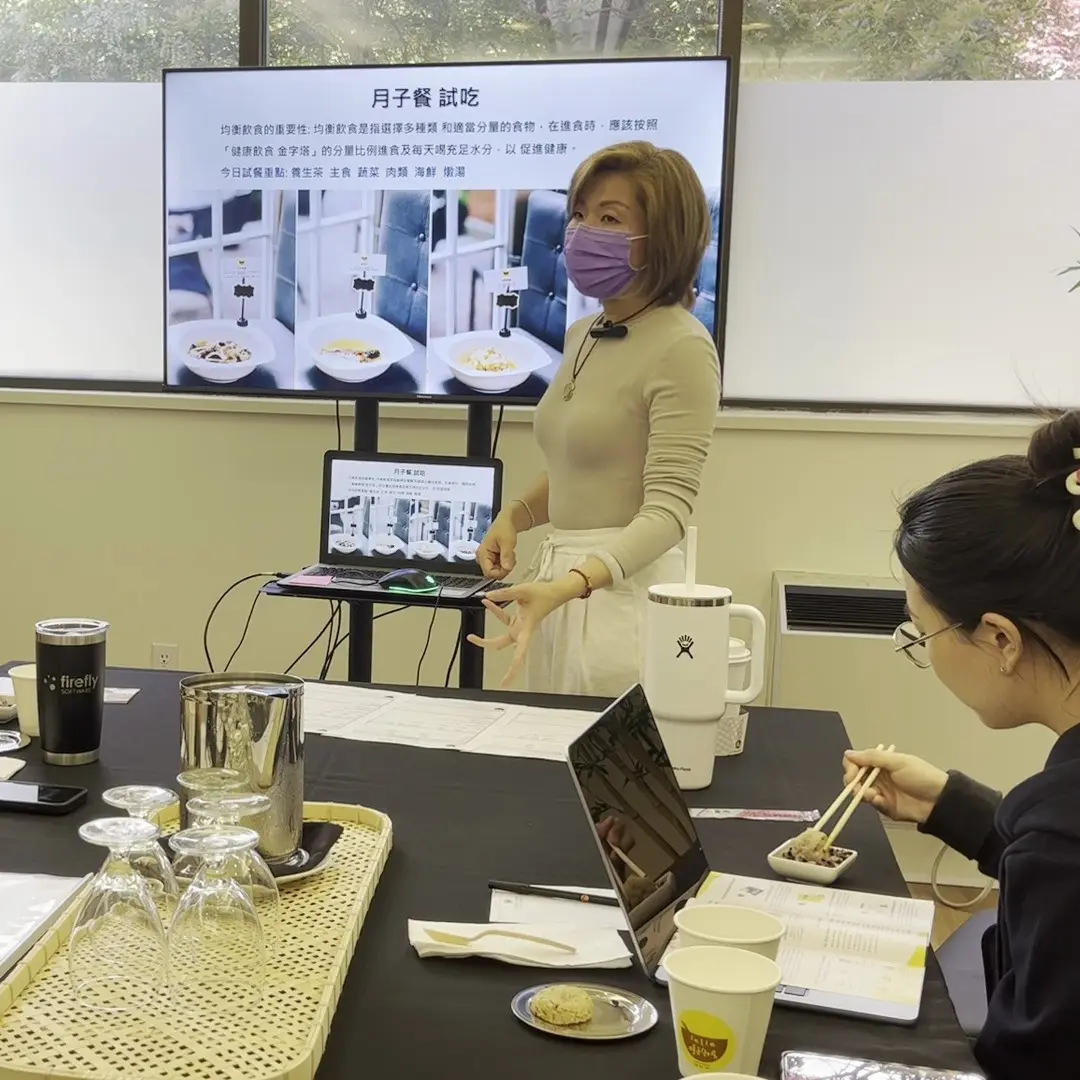
- You taste the food. At a tasting and briefing session, or delivered to you if you cannot attend.
- The month is planned in stages, following the three-phase Cantonese approach rather than one repeating menu.
- Food is cooked fresh daily in our licensed Richmond kitchen, chilled, vacuum-sealed and delivered — daily or every second day — then steamed at home before eating.
- You can ask us things along the way. The questions above are the ordinary business of a confinement month, not an imposition.
What a day actually contains, how the 4, 5 and 7-week plans differ, and which supplements come with each are set out on our meal plans page. Pricing and ordering live on the ordering site, so that what you see there is always current.
Where we deliver
Our fresh daily service covers Greater Vancouver — Vancouver, Richmond, Burnaby, Coquitlam, Surrey and New Westminster among others. The kitchen is in Richmond, and delivery is chilled rather than frozen, so distance genuinely matters: if you are further out, ask us rather than assuming either way.
What's included
- Cooked fresh every day, never frozen Prepared in our licensed Richmond kitchen and delivered chilled, not shipped frozen from overseas.
- A full day of food, not a single meal Three meals, two soups, a tea and a dessert, so nobody in the household has to plan or shop.
- Cantonese soups and food therapy Long-simmered 補身湯水 and traditional tonic items, cooked the way the tradition intends.
- Staged across the month, with someone following your recovery Lighter and cleansing at first, more nourishing later, adjusted for your constitution and how you are actually healing.
- Delivery across Greater Vancouver Daily or every second day, chilled and vacuum-sealed, ready to steam at home.
- A tasting session before you commit Taste the food and ask questions before committing to a month of it.
References
- Pregnancy and parenting resources · HealthLink BC
- Canada's Food Guide · Health Canada
- What to eat while breastfeeding or lactating · Dietitians of Canada
Frequently asked questions
What is a confinement meal service?
A confinement meal service delivers a full day of cooked postpartum food — meals, long-simmered soups, a tea and a dessert — to a new mother's home each day for roughly the first month after birth. The point is not convenience alone. It is that the food itself is chosen for recovery, and that nobody in an already exhausted household has to plan, shop or cook.
How long do most families order for?
Most order for about 30 days, which matches the traditional confinement month. Some extend to 40 days (雙月). What matters more than the exact number is that the food changes across those weeks rather than repeating one menu.
Is the food frozen or shipped?
At Julia's Kitchen it is cooked fresh in our Richmond kitchen and delivered chilled, then steamed at home before eating. Frozen food shipped long distance is a different product; if you are comparing providers, ask directly how and where the food is cooked.
Do you deliver outside Greater Vancouver?
Our fresh daily service covers Greater Vancouver. If you are outside that area, please ask us directly rather than assuming — what is practical depends on the distance and how often you want delivery.
Can I taste the food before ordering a whole month?
Yes. We run a tasting and briefing session, and can also send a tasting meal if you cannot attend in person. Committing to thirty days of food you have never tasted is not a reasonable thing to ask of anyone.